
For daily wear, choose a pair that feels barely noticeable, fits without pinching, uses a metal your ears tolerate, and has backs that stay put. Aim for all-day comfort, not just a light feel when you first put them on. The weight of one individual earring, rather than the combined weight of a pair, is its per-earring weight.
Your daily routine matters: a pair that suits desk work may feel awkward during a brisk walk or a long commute. A pair’s total weight can also hide a difference between its two pieces. Titanium, niobium, and gold are common jewelry materials, but your ears may not tolerate each one in the same way.
You can use a few practical checks to judge the weight, fit, material, closure, and shape. Then consider when to remove your earrings, what to confirm before buying, and how to care for them. Choose a pair that feels good through the parts of your day when you plan to wear it.
Key Takeaways
- Compare the weight of one earring with the weight of one earring.
- Check how the post, hoop, or backing touches your ear.
- Read the metal details for every part that touches your ear.
- Choose a shape that moves well with your routine.
- Remove earrings when an activity could snag or restrict them.
- Follow care instructions for the whole piece, including stones and finishes.
Start with the pair you can forget you are wearing, not the pair that only looks light.
How Should Earrings Fit for All-Day Comfort?
A comfortable pair rests against your ear without pinching, dragging, or making you adjust it every few minutes. Look for a pressure-free fit at the piercing and where the jewelry touches your skin. You should be able to turn your head and move naturally without feeling a sharp tug.
Check both contact points: the visible front and the earring back. A stud’s post and backing should sit without compressing the lobe. The post should not press into the skin, and the backing should not clamp the lobe tightly.
If the backing leaves a pressure mark or the earring keeps tilting, treat the fit as a problem even when the piece feels light.
A stud can have a tiny decorative front and still feel uncomfortable. The post may be too long or short for your lobe, or the backing may press against it. Look at the side of the ear in a mirror, not only at the front.
Hoops and huggies should move without pulling sharply at the piercing. A hoop that catches on your cheek or swings hard when you walk may feel distracting. The hoop’s diameter affects how it moves, while its point of contact should remain comfortable.
Do a simple movement check before a long wear. Turn your head, smile, and bend forward, then notice whether the jewelry shifts or tugs. A decorative front can be large without causing a fit problem if it stays balanced, but overall size alone cannot tell you how it feels.
Give each earring a few minutes on your ears before judging it. Some discomfort appears only after you move or after the backing has been in place for a while. If the backing leaves a pressure mark or the earring keeps tilting, treat the fit as a problem even when the piece feels light.
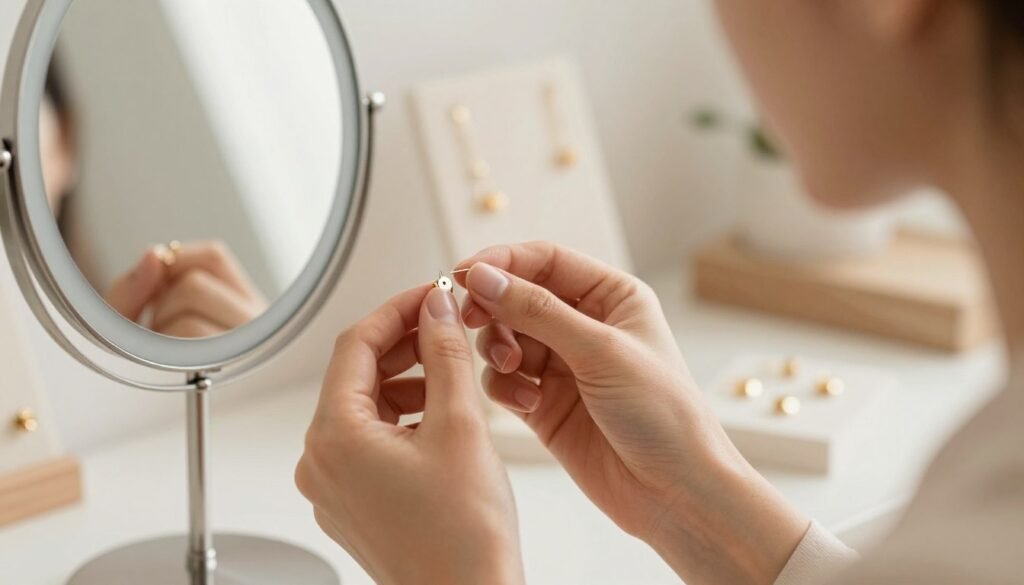
How to Choose Lightweight Earrings for Daily Wear
A useful starting point is to look for less than 1 gram per earring, then judge the design on your own ears. Per-earring weight means the weight of one individual earring, rather than the combined weight of a pair. One gram equals 1,000 milligrams.
Under 1 gram per earring is often considered lightweight as a general rule of thumb. Around 1-2 grams per earring may feel more noticeable during extended wear. Above 2 grams per earring can feel heavy for some people over a long day.
Read the Weight Per Earring
A listing may give the weight of one piece or the pair. A pair weighing 2 grams could mean two equal 1-gram earrings, but the listed figure may refer to one earring instead. Check the wording before comparing.
A pair’s total can conceal a difference between its two pieces. One earring may weigh more because its design or parts differ. That matters if you compare only the pair weight or wear just one earring.
Weight gives you a useful starting point, not a promise of comfort. The style, size, balance, and your own ear can change how a piece feels. A broad or long design may feel more substantial than a compact design at a similar weight.
Compare the Feel, Not Just the Number
Use the same basis for each listing, and check the feel in person when you can. A brief try-on can show whether a pair swings, presses, or feels more noticeable than its number suggests. If you cannot try it, read the full description closely.
- Confirm whether the listing gives one-piece weight or pair weight.
- Compare like with like, using the same unit and basis.
- Check whether both earrings have the same weight.
- Try the pair briefly if you can before deciding.
Do not treat the pair’s total as the weight of one earring. If a listing says 2 grams per pair, that figure is not automatically 2 grams for each piece. Compare per-earring weight across pairs before deciding that one listing is lighter.
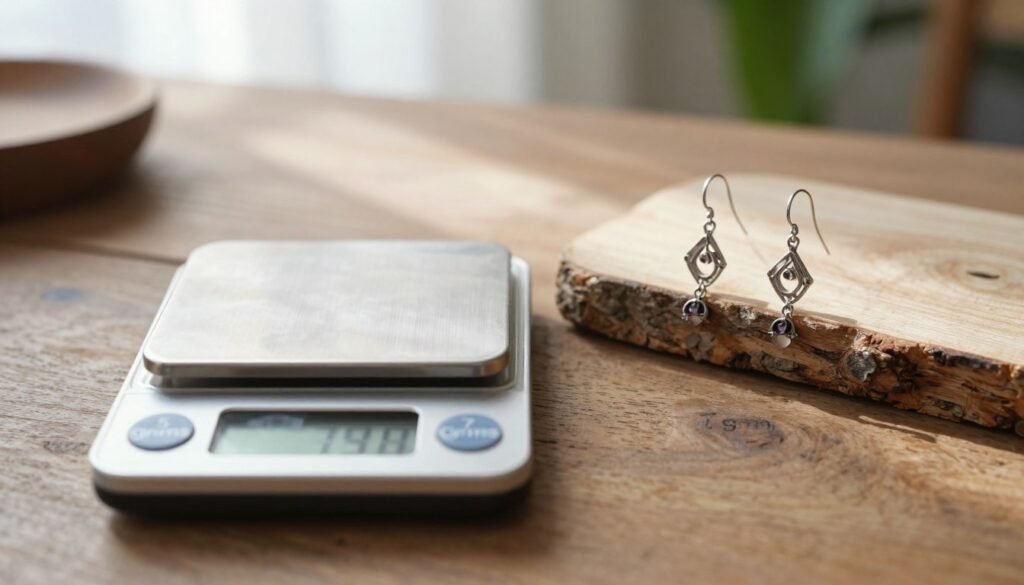
Which Materials Work Best for Sensitive Ears?
Titanium and niobium are useful materials to consider first when you want an alternative to common mixed-metal jewelry. These are hypoallergenic metals often used in jewelry for sensitive ears. The exact parts and composition still matter.
Gold karat numbers describe gold content, not every metal in the alloy. Fourteen-karat gold is 14 parts gold out of 24, while 18-karat gold is 18 parts out of 24. The other parts are alloy metals, and their mix can affect whether a piece suits you.
Titanium and Niobium
Titanium jewelry and niobium earrings are common options to investigate when other jewelry causes discomfort. Both materials are used in jewelry intended for sensitive ears. Ask what the specific piece contains, including any separate parts.
A material name on the front does not establish the makeup of every component. Posts and backs may use a different metal from the visible front. That distinction matters when the post or backing touches your ear for hours.
Gold and Other Alloys
Gold is mixed with other metals to make an alloy. A higher karat number means a larger share of gold, but it does not identify every alloy metal. Ask for the composition when you need to know which metals are present.
Use the table to compare common choices, then match the details to your needs. It is a starting point for questions, not proof that a particular piece will feel comfortable on your ears.
| Material | Common jewelry use | What to verify | Fit for your needs |
|---|---|---|---|
| Titanium | Posts, studs, and body jewelry | Composition of front, post, and back | Consider if you seek a non-nickel option |
| Niobium | Posts and colored jewelry | Material of every ear-contact part | Consider if you want another option |
| 14-karat gold | Rings, studs, and hoops | Alloy metals, which can vary | Gold content alone does not confirm suitability |
| 18-karat gold | Fine jewelry and earrings | Alloy metals, which can vary | Karat alone does not confirm nickel-free jewelry |
Check the composition of the post and backing as well as the visible front.
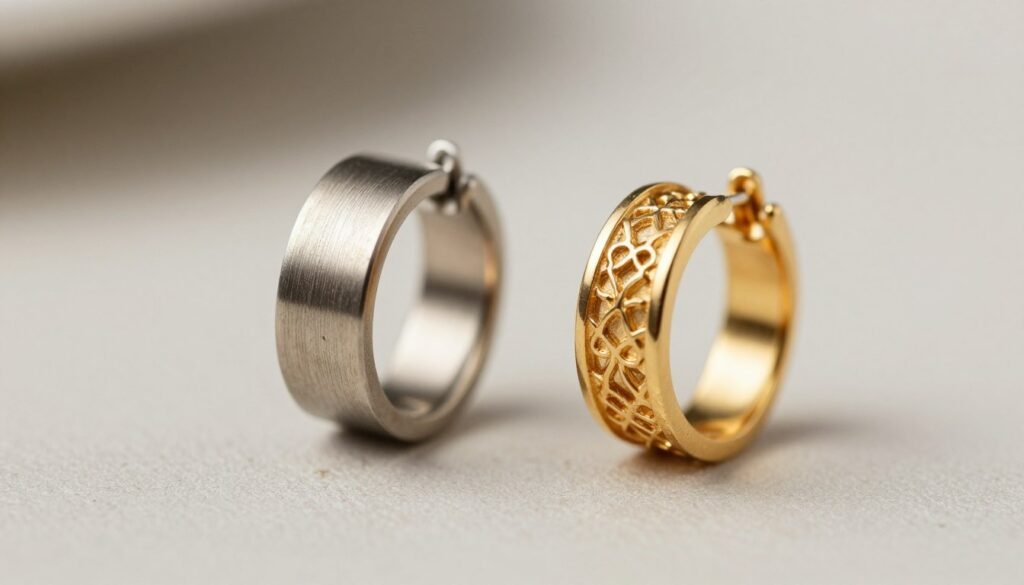
How Can You Tell Whether a Metal Is Suitable for Sensitive Ears?
A clear nickel-free composition claim is more useful than a broad label that only says “hypoallergenic.” Nickel is a common cause of allergic contact dermatitis, a skin reaction from contact with an item. Still, no label guarantees that every person will feel comfortable wearing a piece.
Look for composition details for every part that touches your ear. That can include the post, earring back, and visible front. A nickel-free jewelry claim should apply to the actual piece and its ear-contact parts, not just one component.
A broad hypoallergenic label does not name the metals in a piece. It also cannot promise that your skin will tolerate every material. Clear details let you make a more informed choice, especially if you already know which metals bother you.
Sterling silver and gold can contain other alloy metals. The mark 925 means sterling silver is 92.5% silver; the remaining 7.5% is alloy metal, whose composition can vary. Fourteen-karat and 18-karat gold have different gold shares, but neither karat label alone confirms nickel-free jewelry.
Check product details for each component, not only the material named in a headline. If the description does not identify the post or backing, ask the seller for those details. A clear answer helps you judge the claim without treating a label as a personal test.
Stop wearing a pair if it causes an uncomfortable reaction. Do not try to push through symptoms or wear the same pair again to see what happens. A qualified healthcare professional can help assess persistent or concerning symptoms.
If a pair causes persistent redness, itching, or swelling, stop wearing it and ask a healthcare professional for guidance.
Which Earring Shapes Suit Your Daily Routine?
For a routine with frequent movement, close-fitting studs or small hoops are often easier to manage than long, swinging drops. A low-profile shape can move less around the ear, while a hanging design can catch on hair or clothing. Your usual clothes and activity help guide the choice.
Small does not always mean light. The post, backing, and solid construction also add to the weight, even when the visible front looks tiny. Titanium stud earrings and minimalist hoops are distinct style choices, not promises of a certain weight.
Studs and Small Hoops
Studs sit close to the lobe, so they often work well under headphones or a hat. Small hoops and huggies can move around the piercing. Their movement may suit a busy day, but a hoop can catch on hair or a collar.
A small front may hide a thick post or a solid setting. Look at the whole earring, including its parts behind the lobe, rather than judging it from a front-facing product image. Product photos may not show how it sits from the side.
Drops and Larger Hoops
Larger hoops make more room for movement, while drop earrings hang below the lobe. Either style can work for a calm day or a planned outfit. Dangling pieces may catch on scarves, long hair, or clothing when you turn or bend.
Use the table to match movement and snag risks to your day. No shape suits every routine, so consider what you wear and how often you move your head or upper body.
| Style | Movement | Common snag consideration | Routine that may suit it |
|---|---|---|---|
| Studs | Sit close to the lobe | Posts may catch on fabric | Headphones, hats, and frequent movement |
| Small hoops or huggies | Can shift around the piercing | May catch on hair or collars | Everyday wear with little dangling movement |
| Larger hoops | Swing more as you move | Can catch on scarves or clothing | Calmer routines with fewer snags |
| Drop earrings | Hang and swing below the lobe | Can catch on hair and necklines | Occasions with limited movement |
Choose the shape by how it moves during your day, not by its size in a product image.
How Do You Choose Secure Earring Backs?
The best backing is one that stays engaged through ordinary movement without pressing into your ear. Secure earring backs should feel comfortable as well as stay in place. Fit and correct engagement matter more than choosing a closure by name alone.
Check that each closure is fully engaged and comfortable. A back that can be pushed onto a post is not necessarily secure. Test whether it stays in place and whether it presses against your ear.
Push-Back and Screw-Back Closures
Push backs slide onto a straight post and stay on through friction. Screw backs fasten onto a threaded post, and you turn them to remove them. Check that the push back grips the post and that the screw back turns smoothly.
Neither closure is right for every ear or earring. A tight fit may press into the lobe, while a loose one may shift. The post length and how the backing rests against your ear affect comfort.
Hinged and Lever Closures
Hinged huggie closures close through a small hinge and latch. Lever backs use a hinged arm that closes behind the ear. Check that each moving part closes fully and rests without rubbing your skin.
Use the table to assess the action and feel of each type. A closure can look closed while its latch remains partly open, so check the fit rather than relying on appearance alone.
| Closure | How it fastens | A useful check | Possible comfort concern |
|---|---|---|---|
| Push backs | Slide onto a straight post | Check that the back grips the post | May press tightly against the lobe |
| Screw backs | Turn onto a threaded post | Check that threads turn and engage | May feel bulky behind the ear |
| Hinged huggie closures | Hinged hoop clicks into a latch | Check that the latch closes fully | Hinge or latch may rub the ear |
| Lever backs | Hinged arm closes behind the ear | Check that the arm stays in place | Arm may press or rub behind the lobe |
Before wearing a pair out, check that each closure is fully fastened and does not pinch.
When Should You Remove Earrings During the Day?
Take earrings out before sleep, swimming, or contact sports when they could snag, be damaged, or be restricted. Activity-based jewelry choices help you avoid catching a piece on bedding, gear, or another person. Water, sweat, and moisture can also affect some finishes and metals.
Check the activity before you wear any pair. Close-fitting studs may catch less than dangling earrings or hoops during active movement, but they can still be restricted or snag. Follow any care instructions for water exposure when the maker provides them.
- Sleep: remove earrings to limit snagging on bedding.
- Swimming: remove them to limit moisture exposure or loss.
- Contact sports: remove them when jewelry could catch or rules forbid it.
- Exercise or active movement: check for swinging, snagging, or restrictions.
For sleep, a front that sits close to the lobe may still press against the ear when your head rests on a pillow. Removing earrings avoids that pressure and the chance of a post catching on fabric.
Swimming adds more than a risk of losing an earring. Sweat and moisture can affect some metals and finishes, while water may not suit every setting. Read the care directions for the specific pair before exposing it to water.
During exercise, dangling styles and open hoops can catch on clothing or equipment. A small, close-fitting pair may still be unsuitable if the sport restricts jewelry or the activity could catch it. The rules and the risk both matter.
Check activity rules before relying on a low-profile style for sports or exercise.
What Should You Check Before Buying?
Before choosing a pair, check the weight basis, full material description, fit, closure, and intended use. Consistent comparisons help you judge earrings by the same facts instead of a product photo or label. Product descriptions should state the unit and whether the weight covers one piece or the pair.
Compare matching pairs on the same basis. One gram equals 1,000 milligrams, and a listing may use either unit. A pair’s weight and one earring’s weight are different figures unless the description says otherwise.
- Check whether the weight is per earring or for the pair.
- Read the material composition of every part.
- Check that the post or hoop fits your ear.
- Confirm the closure engages and feels comfortable.
- Decide whether the shape suits your daily routine.
One common mistake is comparing one pair’s per-earring weight with another pair’s combined weight. Convert the units if needed, then make sure each figure describes the same amount of jewelry. If both earrings have equal weight, you can divide the pair total by two.
Check that the material details name the post and backing, not only the visible front. A product description may list one main metal without explaining every component. The full details matter if you already know that certain metals bother your ears.
Think about how the pair will sit and move in the clothes you wear most. A product photo can hide a long post, a backing that presses, or a drop that catches on a collar. Read the dimensions and closure details when they are listed.
If weight or composition details are missing, ask the seller for them before choosing. Ask whether the stated weight covers one earring or the pair, and what metals make up each ear-contact part. Keep the comparison consistent by checking the same details for every pair you consider.
How to Clean and Store Daily-Wear Earrings
For many durable metal earrings, wipe away residue with a soft cloth and dry the pair fully before storage. Gentle care helps avoid extra wear on the surface. A soft cloth is a low-abrasion choice for many durable metals.
Check care guidance before using water, soap, or jewelry cleaner. Cleaning products and water may not suit porous stones, glued settings, or every finish. Use directions for the whole earring, not only its metal parts.
Care has two simple stages: cleaning and drying. Wipe the piece with a soft cloth, then dry it fully before putting it away. If the maker gives specific care steps, follow those instead of trying a new cleaner.
Store earrings separately so they do not tangle or rub against other pieces. A small case or divided tray can keep posts and drops from catching on nearby jewelry. Give delicate or plated pieces space from harder items.
Porous stones, glued settings, and plated or delicate finishes may need different care from durable metal.
For a pair with more than one material, the most delicate part sets the care needs. A metal front may tolerate wiping, while its stone or finish needs a gentler method. Use the care method suited to the whole earring, not just its metal front.
Conclusion
A comfortable everyday pair is the one that suits your ears, your routine, and the way you like to wear jewelry. Daily comfort comes from the combined fit, per-earring weight, material, and closure. A good choice works as well during an ordinary day as it does when you first try it on.
Choose one candidate pair and read its product description before wearing it. Confirm whether the stated weight covers one earring or the pair, then check the full material composition for the front, post, and backing. Before your next wear, confirm the pair’s weight basis and material composition, then check that it sits comfortably.